

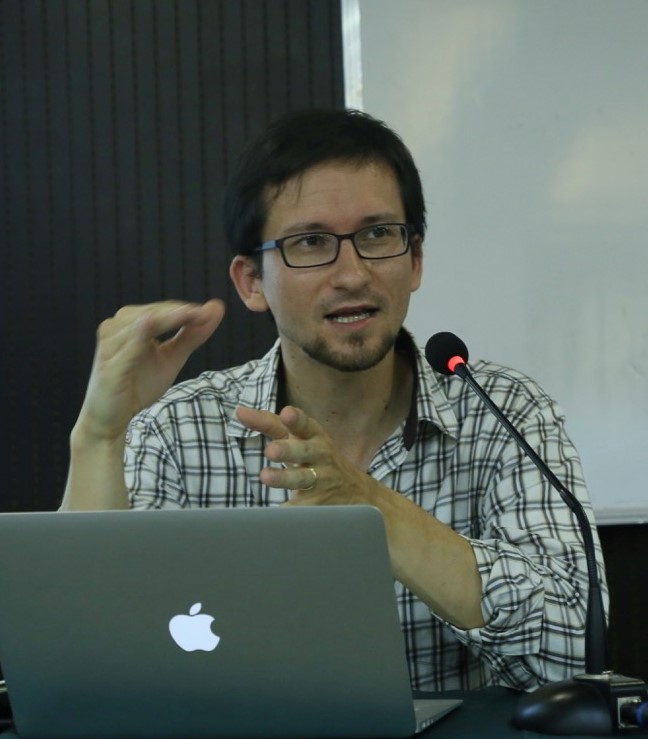
Guillaume Dutournier
Lecturer
Geographic area
China
Fields of study
Anthropology, History
Year of entry into function at EFEO
01/2016
Assignment
Guillaume Dutournier
Lecturer
Geographic area
China
Fields of study
Anthropology, History
Research themes / topics
Intellectual history (Neo-Confucianism, Sinology)
Cultural anthropology (heritage studies)
EFEO Lines of research
Religions, representations, and powers
Research in progress
A first project focuses on literary controversies in neo-Confucian circles during the Song dynasty. Following in the footsteps of Marcel Granet and his successors, and in dialogue with the pragmatic sociology of controversies, it considers intellectual practice in pre-modern China as a shared repertoire of guiding ideas, discursive forms and ways of acting. Discussions between rival school masters are placed back into their epistemic logic and networks of sociability, in turn feeding into a comparative anthropology of knowledge relations.
A second project focuses on the Chinese heritage experience and the creation of cultural values in the context of contemporary China. Based on a comparative analysis of the trajectory of the concept of heritage in China, and several field studies focusing in particular on places of worship (Shanxi) and a network of artisans (Shandong), we examine certain aspects of the current ‘intangible cultural heritage fever’ encouraged by the authorities. The aim is to place the Chinese heritage dynamic in the long-term context of its emergence, as well as in the composite and evolving nature of its current meanings.
This dual thematic focus in turn feeds into a reflective effort on the history of Sinology. The institutionalisation of academic Sinology in the 19th and early 20th centuries played a key role, particularly in France, in the emergence of the social sciences as autonomous disciplines. At a time when the global divide between the ‘universalisation’ and ‘indigenisation’ of these same sciences is widening, it is worth revisiting this seminal moment in Chinese studies, placing it in the context of scholarly dialogue, but also in its fundamental connection to a reflexive approach that needs to be revisited and brought into dialogue with equivalent approaches in the current Chinese academic world.
Studies and training
- 2006, Master’s degree in Chinese Studies, INALCO
- 2014, Doctorate in Chinese Studies, INALCO
Professional history in EFEO
- Head of the Beijing Centre from 2016 to 2021, then from 2023 to 2024
- Member of the Scientific Council since 2024
- Head of the Shanghai Centre since 2025
Professional history
- Research associate at UMR 8173 China Korea Japan (CCJ) since 2014
Translated with DeepL.com
Bibliographie (HAL)
Ouvrages
Guillaume Dutournier, Max Jakob Fölster. Shanggu fengchao yu yichanhua shijian de zhongwai bijiao 尚古风潮与遗产化实践的中外比较. Ecole française d'Extrême-Orient. In press, Faguo hanxue/Sinologie française,vol. 19. ⟨hal-05268922⟩
Chapitres d‘ouvrage
Guillaume Dutournier, Congcong Ren. 遗产现代性:中欧轨迹的分与合. Ecole française d'Extrême-Orient. Faguo hanxue 法国汉学, 19, Zhonghua shuju, pp.1-37, In press, Faguo hanxue 法国汉学 / Sinologie française. ⟨hal-05268812⟩
Guillaume Dutournier. Combining Meanings in the Popular Realm: Buddhist and Governmental Engagements in a Syncretic "Scenic Area". Yoshiko Ashiwa, David L. Wank, Ji Zhe. The Metamorphosis of Buddhism in New Era China: Between State, Culture, and Religion, Bloomsbury, 2025, 9781350504561. ⟨hal-05268860⟩
Guillaume Dutournier. An Adventure Called “Sishu”: The Tensions and Vagaries of a “Holistic” Educational Experience (zhengti jiaoyu) in Today’s Rural China. The Varieties of Confucian Experience, BRILL, pp.262-301, 2018, ⟨10.1163/9789004374966_011⟩. ⟨halshs-03156226⟩
Guillaume Dutournier. Le Daxue chez Zhu Xi (1130-1200) et Lu Jiuyuan (1139-1193). Émergence et appropriations d'un classique sous les Song. Collège de France, Institut des hautes études chinoises. Anne Cheng (sous la direction de), Lectures et usages de la Grande Étude, pp.113-152, 2015, 2857570740. ⟨hal-03983247⟩
Guillaume Dutournier. « Controverse et identité lettrée », introduction à Zhu Xi & Lu Jiuyuan, Une Controverse lettrée. Correspondance philosophique sur le Taiji. Une Controverse lettrée. Correspondance philosophique sur le Taiji, Belles Lettres, pp.69-119, 2012, 9782251100104. ⟨hal-03983325⟩
Articles dans une revue
Guillaume Dutournier. « Family Schools » in Mainland China and Taiwan: Three Perspectives on a Traditionalist Education. Extrême-Orient Extrême-Occident, 2011, 33, pp.172-210. ⟨10.4000/extremeorient.195⟩. ⟨hal-03983268⟩
Guillaume Dutournier, Zhe Ji. Social experimentation and “popular Confucianism”: the Case of the Lujiang Cultural Education Centre. China perspectives, 2009, 2009 (4), pp.71-86. ⟨10.4000/chinaperspectives.4925⟩. ⟨hal-03983310⟩
Guillaume Dutournier, Ji Zhe. Expérimentation sociale et « confucianisme populaire ». Le cas du Centre d'éducation culturelle de Lujiang. Perspectives chinoises, 2009, 109, pp.71 - 86. ⟨10.3406/perch.2009.3972⟩. ⟨halshs-02515330⟩
Guillaume Dutournier. [compte rendu] Ari Daniel Levine, Divided by a common language. Factional Conflict in Late Northern Song China, 2008. Études Chinoises, 2008, pp.387 - 392. ⟨halshs-02515317⟩
Guillaume Dutournier. [compte rendu] Martin Kern (ed.), Text and Ritual in Early China, Seattle/Londres : University of Washington Press, 2005. xxvii-332 pages. Études Chinoises, 2007, pp.314 - 321. ⟨halshs-02515322⟩
N° spéciaux de revue
Guillaume Dutournier, Florence Padovani. Cultural Values in the Making: Governing through Intangible Heritage. China perspectives, 2021/3, 2021, ⟨10.4000/chinaperspectives.12070⟩. ⟨hal-03983319⟩
Communications dans un colloque
Guillaume Dutournier, Shanshan Zheng. Questions méthodologiques et conscience patrimoniale chez Yang Kun (1902 - 1998). Le travail réflexif d’un durkheimien chinois face au fait culturel. Autour de l’Institut Franco-Chinois (1921-1950). Diaspora étudiants, circulation des savoirs et relations institutionnelles sino-françaises, Université Jean Moulin Lyon 3; IETT, May 2025, Lyon, France. ⟨hal-05086550⟩
Autres publications scientifiques
Guillaume Dutournier, Paul Charon. « Le confucianisme, un modèle politique ? Une réponse à Daniel A. Bell ». 2010. ⟨hal-03983340⟩
Traductions
Guillaume Dutournier. Une controverse lettrée : "Correspondance philosophique sur le taiji". 2012. ⟨hal-03626804⟩
Guillaume Dutournier. [Traduction] « Sortir du vingtième siècle » : dialogue entre Gao Xingjian et Liu Zaifu. 2008, pp.130 - 134. ⟨10.3406/perch.2008.3644⟩. ⟨halshs-02515341⟩
Sebastian Veg, Guillaume Dutournier. [Traduction] Fiction utopique et examen critique : la Révolution culturelle dans «L'Âge d'or» de Wang Xiaobo. 2007, pp.78 - 91. ⟨10.3406/perch.2007.3575⟩. ⟨halshs-02515347⟩
Thèse
Guillaume Dutournier. Zhu Xi et Lu Jiuyuan. Description d’une relation lettrée dans la Chine des Song (second XIIe siècle) : un essai d’anthropologie du savoir. Histoire. Institut National des Langues et Civilisations Orientales- INALCO PARIS - LANGUES O', 2014. Français. ⟨NNT : 2014INAL0033⟩. ⟨tel-01368942⟩
Posters de conférence
Claire Vidal, Guillaume Dutournier, Adeline Herrou. Le WikiShifu ou la constitution d’un vocabulaire de spécialistes religieux chinois. Vieux maîtres et nouvelles générations de spécialistes religieux aujourd’hui en Chine : ethnographie du quotidien et anthropologie du changement social, Mar 2016, Nanterre, France. ⟨hal-01969043⟩