

History
Since the 1980s, the EFEO has been active in Burma (Myanmar) through the inventory of monuments in Pagan, carried out by Pierre Pichard as part of a UNESCO project (which ended in 1997). In 2002, the EFEO established itself in Yangon, the capital, under the leadership of Jacques Leider. Until 2008, the Yangon centre was housed at the Centre for History and Tradition (CHAT), an institution under the international supervision of SEAMEO (Southeast Asian Ministers of Education Organisation).
Jacques Leider served as director of the Yangon centre until 15 September 2021. He was succeeded by Gregory Kourilsky.
Translated with DeepL.com
Presentation
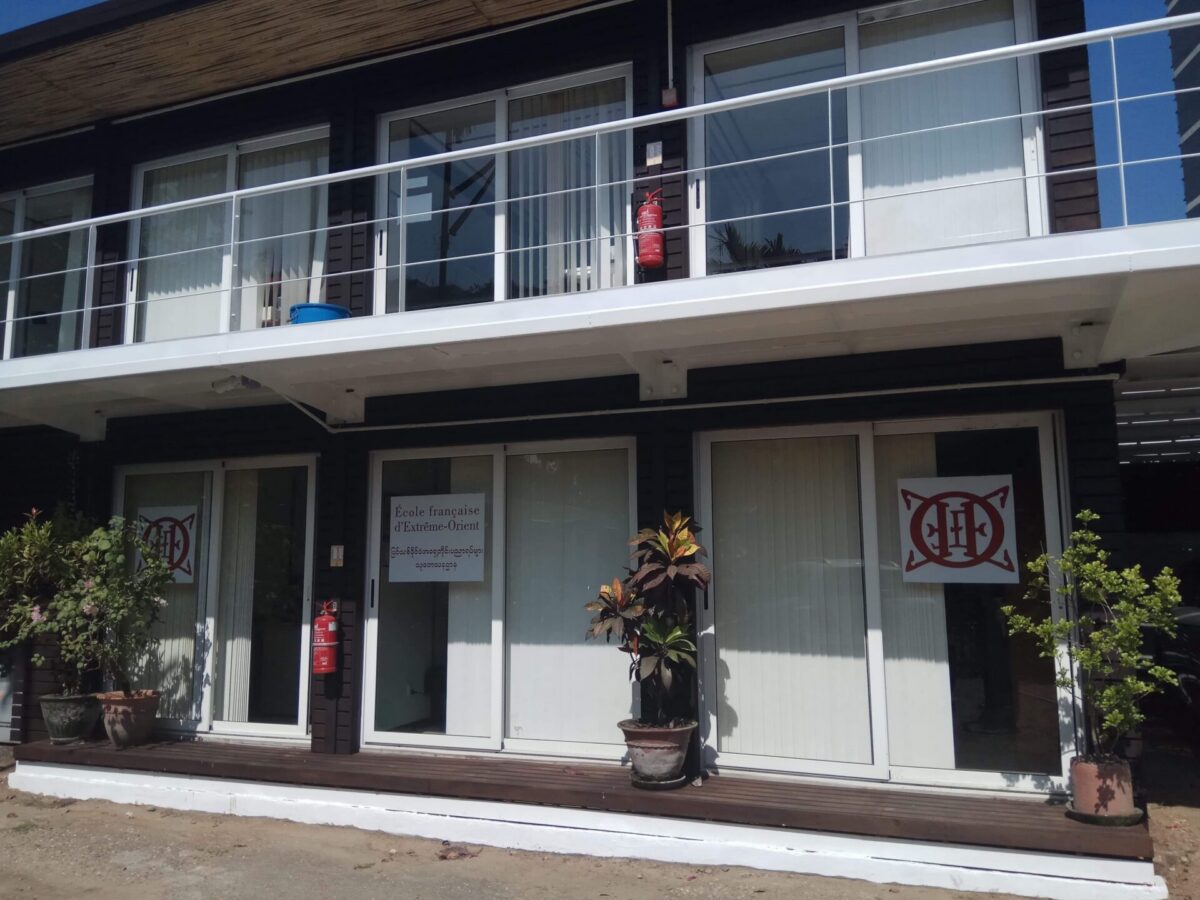
Since 2008, the EFEO has been located on the site of the French Cultural Centre (now the French Institute in Burma, IFB), which brings together the cultural and linguistic services of the French Embassy. The EFEO centre has two modular buildings in the IFB gardens, divided between a research office and a documentation area open to local and international researchers and students.
Translated with DeepL.com
Partners and partnerships
In addition to its established cooperation with the Centre for History and Tradition (CHAT), the centre regularly collaborates with the Department of International Relations at Mandalay University.
Translated with DeepL.com
Research areas
In the early 2000s, projects conducted at the Yangon centre focused mainly on cataloguing and transcribing unpublished manuscripts from Rakhine State, the study of which revealed new information about the historiography and political, cultural and religious history of the Arakan Kingdom (Mrauk-U between the 15th and 18th centuries). Starting in 2005, a project to collect Arakanese inscriptions led to the creation of the first systematic collection of lithic evidence for this region of Burma.
Research on the early history of the Konbaung dynasty (1752-1885), which began in 2007, has led to a critical reading of the royal chronicles, examined in relation to royal ordinances and edicts, particularly for the reign of Alaungmintaya, founder of the dynasty.
Since 2015, pre-colonial and colonial Buddhism in Arakan and south-eastern Bengal has been another area of research for the centre. More recently, the case of the Rohingya Muslims in the border region between Bangladesh and Burma has mobilised a significant part of the research conducted by the Yangon centre.
Translated with DeepL.com
Activities
The coup d’état of 1 February 2021 and the ensuing political and humanitarian situation led the EFEO to suspend its activities in Myanmar at the end of 2023. An agreement was signed on 30 November 2023 with the IFB, whereby the EFEO temporarily made the two modular buildings it owns available to the latter.
Translated with DeepL.com
Person in charge
École française d'Extrême-Orient
c/o Institut français de Birmanie
340 Pye Road, Sanchaung township
Yangon, Myanmar
+95 (1)536 900
Dernière modification : 3 mars 2026