

History
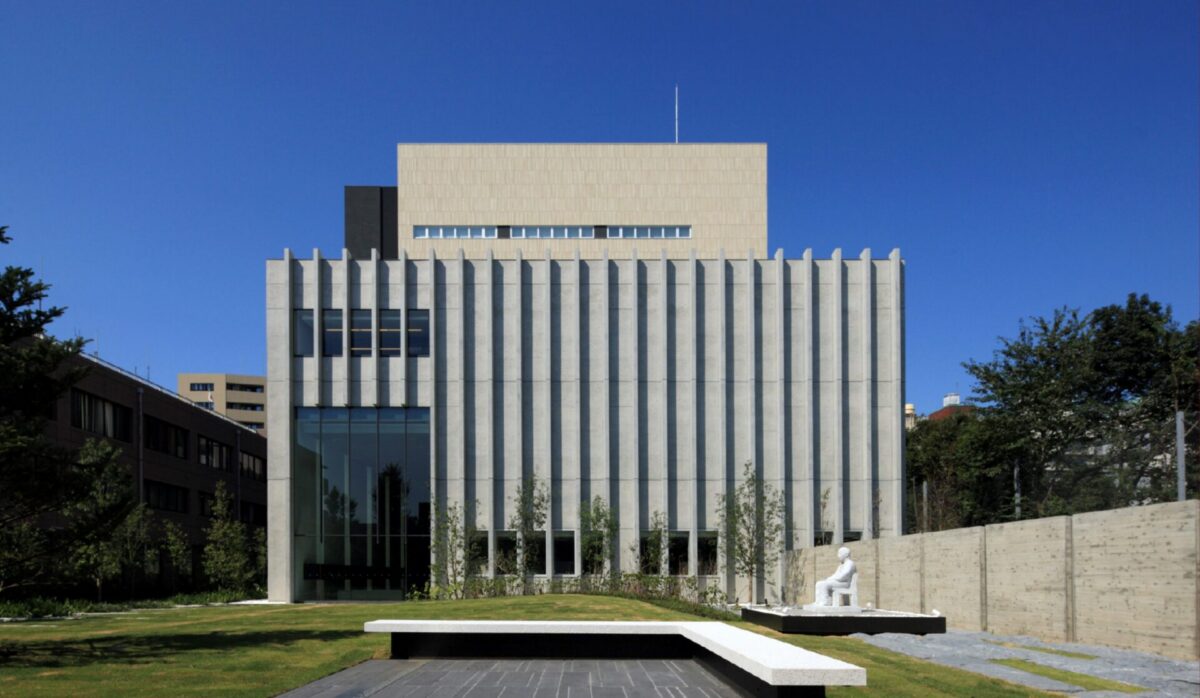
The EFEO Centre in Tokyo, established in 1994, is located within the Tōyō Bunko (Oriental Library), the largest library dedicated to Asian studies in Japan and one of the most active research institutions in the field of Asian studies worldwide. The agreement between the EFEO and this institution provides for the exchange of scientific documentation and publications, the exchange of researchers, and the implementation of joint projects.
The Tōyō bunko fulfils a triple function: library, museum and research centre. Its buildings consist of storage rooms where the collections are kept, a reading room, a research library, seminar rooms for researchers, and a museum. The EFEO Centre’s office is located on the seventh floor. The Tōyō Bunko’s collection includes nearly one million works, as well as thousands of maps, prints and excavation reports, organised around the Morrison Collection (acquired in 1917 and comprising some 24,000 titles). Added to this are the Cordier Western collection (deposited in 2021) and several private libraries belonging to researchers specialising in European works. The Western language collections sit alongside a vast collection of Chinese and Japanese books (the Iwasaki collection), as well as collections in Mongolian, Tibetan, ancient Uyghur and Indo-Persian languages related to Islamic areas.
As a research institution, the Tōyō Bunko’s mission is to develop and promote research on Asia in the humanities and social sciences. Several collaborative research projects are currently underway: six projects on China; five on Central and Western Asia; three on Northeast Asia; two on India and Southeast Asia; one on Islam; one on Tibet; and one on Japan. The Tōyō Bunko has been and remains an important centre for Dunhuang and Turfan studies. Among the most famous specialists in this field are Dohi Yoshikazu (1933-2020) and Takata Tokio, the current director of the Tōyō Bunko Museum.
Presentation
Researchers at the EFEO Centre in Tokyo have developed collaborations with various institutions based in France and Asia. Over the years, the Centre has launched several research projects on literary networks in Edo Japan (1603–1867), the history of international exchanges in East Asia and Eurasia in the modern era, the ‘discovery of Buddhism’ in Western sources (1550-1850), the history of art and aesthetics in modern Japan, etc.
More recently, François Lachaud, head of the Centre between 2017 and 2024 and a specialist in Japanese Buddhism, initiated a research programme on Chinese popular images collected by two Frenchmen in Beijing and Shanghai, the Jesuit Henri Doré (1859-1931) and the journalist and publisher Albert Nachbaur (1879-1933).
Costantino Moretti, head of the Centre since 2024, is involved in various research programmes on medieval China. He has developed new series of lectures on Sinology, which have made it possible to invite internationally renowned Chinese, Japanese and European researchers. These lectures, organised in cooperation with the Tōyō Bunko, focus in particular on the Buddhist art of Dunhuang, Chinese and Japanese Buddhism in the medieval period, and the study of medieval manuscripts preserved in China and Japan.
The Centre welcomes EFEO fellows and researchers, as well as researchers affiliated with other French and international institutions, who are staying in Japan.
In addition to its main partnership with the Tōyō Bunko, the EFEO Centre also maintains close ties with the EFEO Centre in Kyoto, the French Institute for Research on Japan (Maison Franco-Japonaise), the French Embassy in Japan and the French Institute in Japan.
Partners and partnerships
- Tōyō Bunko
- French Institute for Research on Japan (Maison Franco-Japonaise)
- French Embassy in Japan
- French Institute in Japan
Research areas
History, religious history, art history.
Activities
- Lecture series
- Organisation of study days and symposiums
Translated with DeepL.com
Person in charge
École française d'Extrême-Orient
Tōyō bunko Honkomagome
2-28-21, Bunkyō-ku,
Tōkyō 113-0021,
Japon
Opening hours
Du lundi au vendredi, de 9h à 17h
Bibliothèque (Tōyō bunko)
Lundi, mercredi, jeudi et vendredi, 9h30-17h00
+ 81 03-3942-2119
Dernière modification : 14 septembre 2026