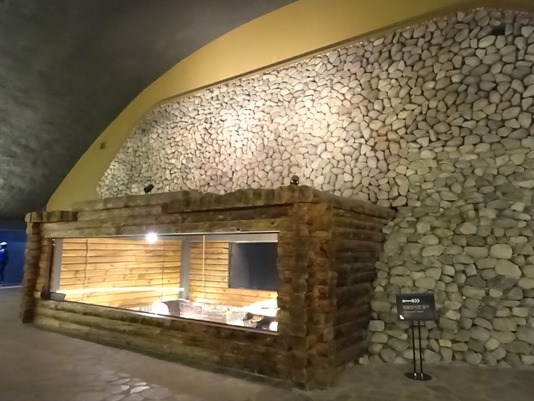
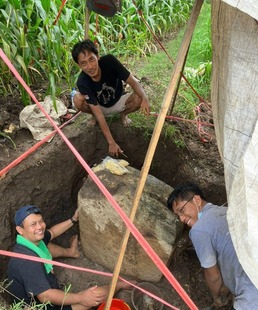
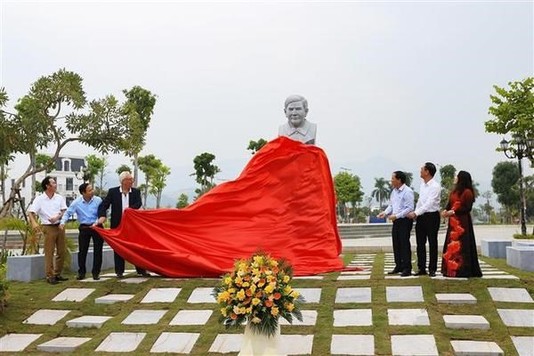
Illustration: Inauguration ceremony of the memorial in honour of French archaeologist Madeleine Colani. Photo: VNA. "This little lady of a certain age, former teacher, member of the Indochina geological service and correspondent of the EFEO, once made an enviable reputation for herself as a tireless runner in the bush as well as in international conferences. Since 1927, her research has made it possible to identify the Hoabinhian technique and culture (40,000 to 4,000 years BP), now belonging to the Upper Paleolithic, characterised by tools on oblong pebbles found within shell clusters, notably in the rock shelter of Làng Vành (Yên Phú commune, Lạc Sơn district). This site, which we visited, is now a national heritage site (coordinates 20.495608026840927, 105.46952647080208). In Hanoi, during the 1932 Congress of Far Eastern Prehistorians, she defined the Hoabinhien and its originality, elevating it to the rank of regional typo-cultural specificity. For the 60th anniversary of Madeleine Colani's work, an international colloquium held in Hanoi in 1993-1994, on the initiative of Professor Hà Văn Tấn, drew up a report on the question, but also highlighted the difficulty of establishing a clear link between the tools found in the excavations, which were similar to those found on other sites in South-East Asia occupied by hunter-gatherers, and the existence of a cultural phenomenon that was unique and characteristic of the Hoà Bình region. Therein lies an ambiguity because the term Hoabinian (as in Neanderthal) is typological and does not presume an origin. In the scientific literature, the adjective "hoabinhian" is nowadays used in a broader sense than in 1932 and it is now commonly used in English-language works to describe tools made of pebbles cut on one side and found in Southeast Asia. It is true that, seen from Hoà Bình, the stakes go beyond the scientific domain. Yesterday, surrounded by a battalion of Mường ladies in traditional dress, the highest provincial and municipal authorities were gathered to cut the ribbon and unveil the statue of the one who remains the inventor of Hoà Bình culture, a scientific name that extends far beyond Vietnam, but which the population of the Mường ethnic group, the majority in the province, claims to be the heir. In short, 90 years later, we are grateful to Madeleine Colani for having incidentally contributed, through her work, to the strengthening of local identity by giving it a scope and historical depth that are bearers of legitimacy and, consequently, of uniqueness and pride. Philippe Le Failler, Hanoi, 23 November 2022." Références:
- Pautreau Jean-Pierre. Le Hoabinhien, 60 ans après Madeleine Colani. Conférence Anniversaire, Hanoi, 28 décembre 1993 – 3 janvier 1994. In: Bulletin de la Société préhistorique française, tome 91, n°3, 1994. p. 175 - Hubert Forestier and Heng Sophady. Le Hoabinhien ou le paradigme égaré de la modernité européenne en préhistoire. L’exemple du Cambodge avec la grotte de Laang Spean (Province de Battambang), communication au CPF 2021 : 29e Congrès Préhistorique de France, Hiatus, lacunes et absences : identifier et interpréter les vides archéologiques, 31 mai-4 juin 2021 Toulouse (France) sciencesconf.org:cpf2021:339014 |